Follow us on LinkedIn
You are certain to come across the P/E ratio in various areas as an investor. Although simple, it can be significantly useful when evaluating companies. We have covered the P/E ratio before. In this article, we will provide concrete examples of how to use it. An online calculator is presented at the end of this post.
What is the P/E Ratio?
The P/E ratio is a relative measure of a company’s stock price to its earnings per share (EPS). It has been one of the most reliable ratios for investors when valuing companies. Although you can use other financial ratios, the P/E ratio is straightforward to calculate.
The P/E ratio tells you how much money you pay for every $1 earned from the investment. This information can be valuable when investing in companies based on their relative returns. However, it is crucial to know why, when, and how to use the P/E ratio.
Why do we use the P/E Ratio?
A company’s P/E ratio shows you the relative value of its shares. However, it is not helpful on its own. You must use the P/E ratio comparatively to reap maximum benefits. Nonetheless, it can help you decide between various stock investment options when used comparatively.
The P/E ratio can help determine the growth to expect when investing in companies. On top of that, it can be an indicator of the market as a whole to compare companies from the same industry. However, we recommend using this ratio with other financial ratios for the best results.
How to use the P/E Ratio?
Using the P/E ratio is straightforward. First, you need to select some companies for analysis. For each, you must obtain their stock price and earnings per share. You can get this information from various sources. Once you have those items, you can put them in the following formula.
P/E Ratio = Share Price / Earnings Per Share (EPS)
You must also understand what the P/E ratio means. Usually, a high P/E ratio can help identify companies with growth stocks. On the other hand, a low P/E ratio shows a value stock. However, each of these can have an adverse side to them.
Where to use the P/E ratio?
We recommend you use the P/E ratio as a primary analysis tool. Similarly, it provides the best results when used comparatively between similar companies. Don’t use the P/E ratio on its own or for advanced stock analysis. In these cases, you won’t get the desired results.
Furthermore, don’t use the P/E ratio as the only tool when analyzing various companies. We recommend utilizing the ratio as a part of several other tools. You can also use other versions of P/E ratios to enhance your decision-making.
Example
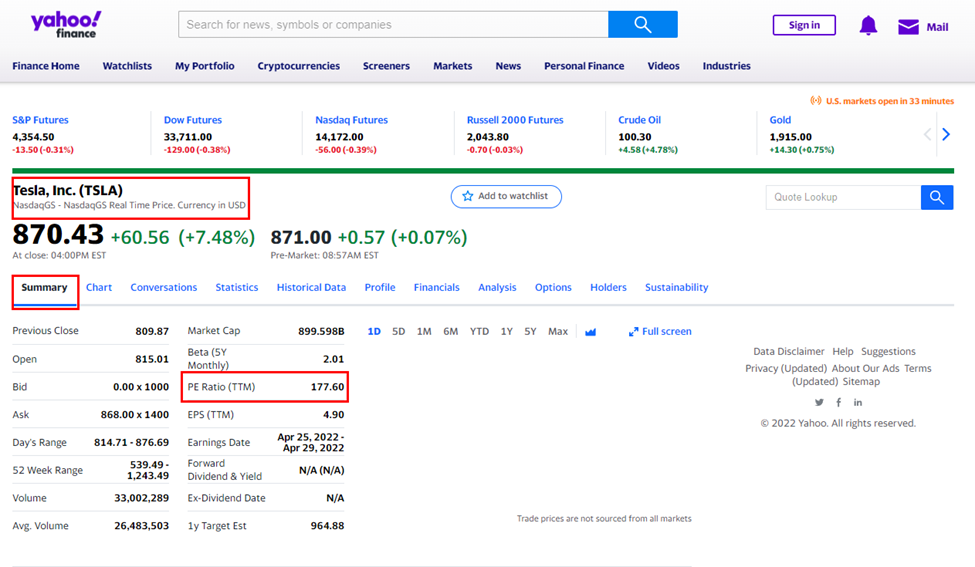
You can obtain a company’s P/E ratio from various sources. We recommend using Yahoo Finance as it provides different versions of this ratio. First, you must find the company on the platform. For this example, let’s consider Tesla Inc. (TSLA).
When you find Tesla on Yahoo Finance, you can get its P/E ratio for the last 12 months under the “Summary” tab.
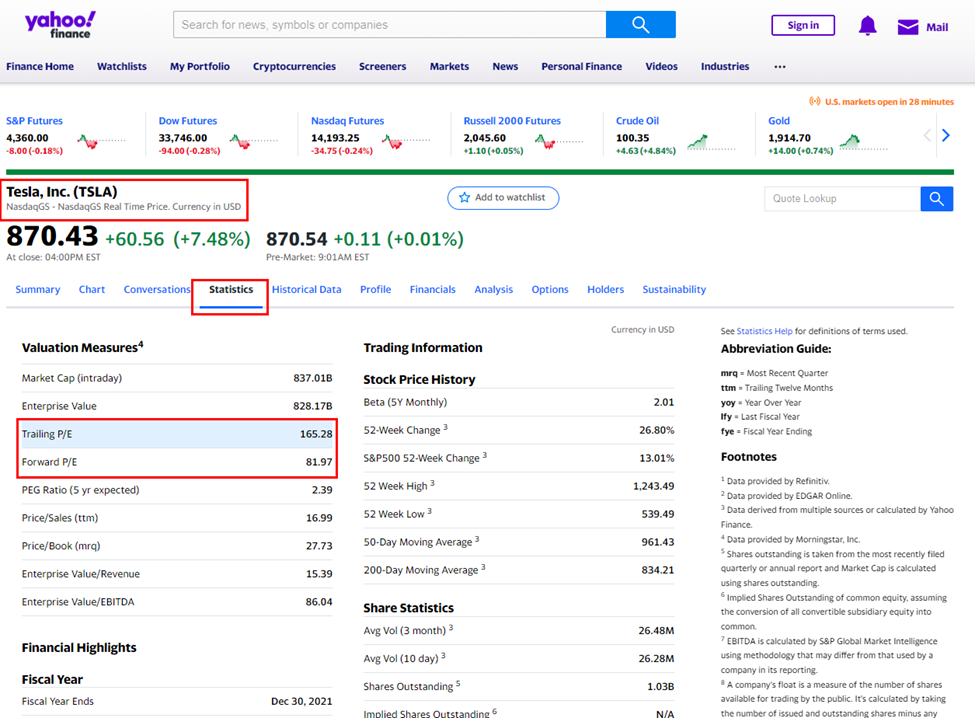
You can also visit the “Statistics” tab for further information and analysis. Other types of the P/E ratio are available under the “Valuation Measures” section.
Conclusion
The P/E ratio is an essential financial ratio to determine a company’s value. However, you must use it comparatively. It is readily available on various platforms once you find your desired company. We recommend you add it as a part of your analysis tools.
Calculator
Use the dropdown menu highlighted in yellow to choose the stock.
Check out other finance calculators on our website.
Let us know what calculator you want us to develop in the comment section below.
Further questions
What's your question? Ask it in the discussion forum
Have an answer to the questions below? Post it here or in the forum





Prime Minister Keir Starmer’s promise to “get Britain building again” will quickly face a shortage of skilled workers in the very industries he’s hoping will power the turnaround.
